Why Smart Pet Feeders Get Returned — and the Design Details That Prevent It
Most smart pet feeder returns trace back to a handful of design issues: jams, outages, determined pets and hard-to-clean parts. A returns-prevention checklist for retailers and distributors.
For a retailer or distributor, a smart pet feeder is not sold when it leaves the warehouse — it is sold when it is still on the customer's floor, feeding on schedule, ninety days later. Returns and one-star reviews in this category are rarely random. They trace back to a small set of design issues that buyers can check before they commit to a product line.
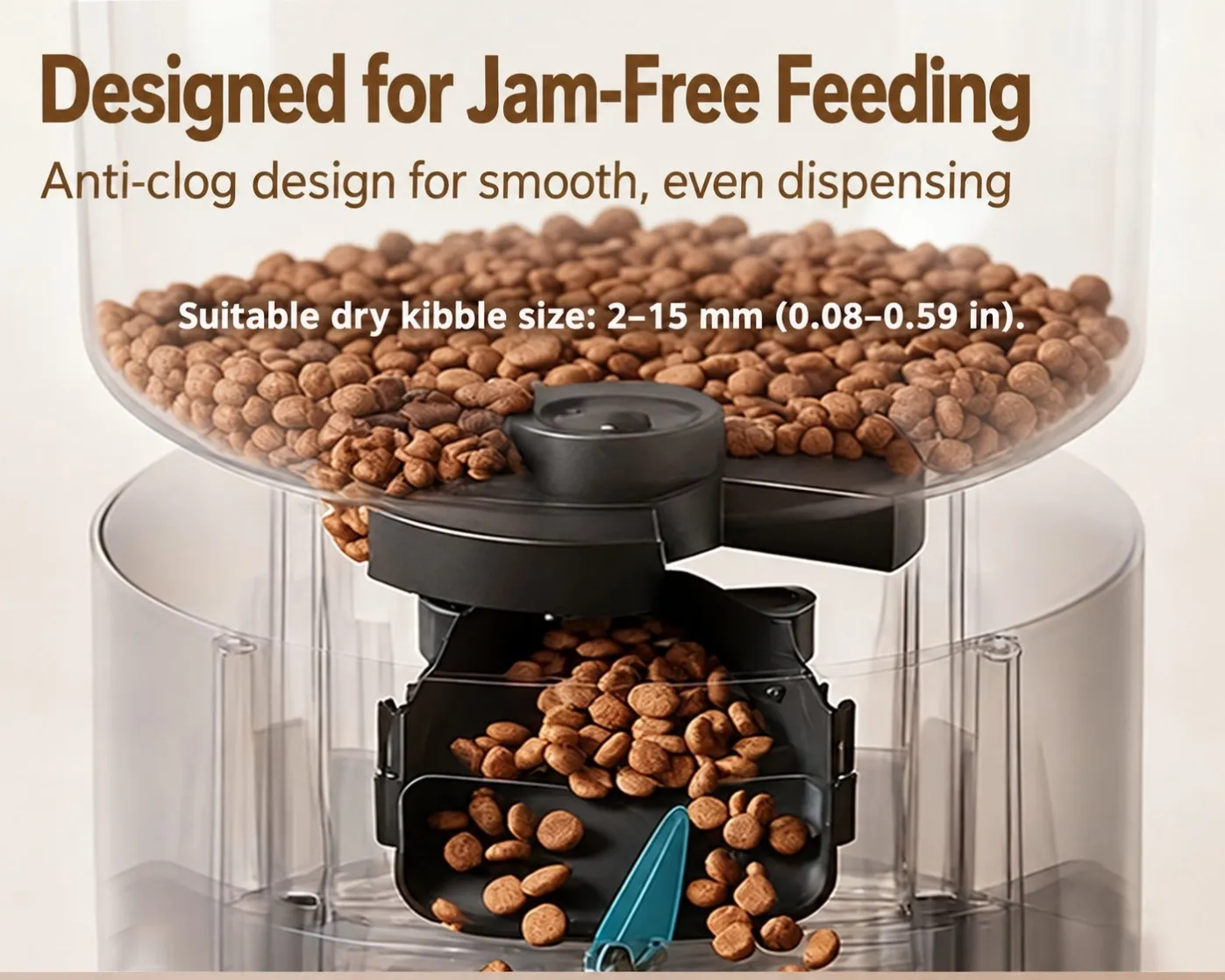
Jam-driven returns. The single most common failure is food that stops moving. Kibble varies widely in size and shape, and many households feed mixed diets — dry kibble blended with freeze-dried or air-dried pieces. A dispenser tuned for one uniform kibble size will eventually meet a piece it cannot pass, and a missed meal is the kind of failure customers do not forgive in a review. The checks: a stated kibble range (our feeder handles 2–15 mm, covering dry, freeze-dried, mixed and air-dried food), an anti-clog dispensing design, and an infrared sensor that detects a blockage instead of silently failing.
Outage-driven returns. A feeder that only works while the power and Wi-Fi do is a feeder that fails during every storm and router restart — usually while the owner is away, which is exactly when the product was supposed to help. Dual power supply with battery backup (this model runs its backup on 3 × D batteries) keeps scheduled meals going through an outage, and it is one of the first specifications worth putting on the listing page, because it answers the question anxious buyers actually ask.
Pet-driven returns. Pets test products professionally. They tip, pry and chew. Non-slip feet and a stable body reduce tipping; a nylon-braided, chew-resistant cable removes the most attractive target; and a hopper design that dispenses by mechanism rather than by access keeps a determined cat from self-serving between meals.
Hygiene-driven returns. Food residue in a device that cannot be taken apart becomes smell, and smell becomes a return. A removable stainless steel bowl and removable parts that can be washed properly are not premium extras in this category — they are the difference between a product that survives daily use and one that comes back in month two.
Support-ticket drivers. "Did it feed?" is the question behind a large share of support contacts. Dual wide-angle cameras with two live views, app feeding records and activity alerts let owners verify a meal happened instead of messaging your support team — and two-way audio lets them call the pet to the bowl, which is the feature owners actually show their friends.
Listing accuracy prevents the rest. A meaningful share of returns are expectation errors: capacity, dimensions, packaging and certifications stated loosely or not at all. This feeder's data is published in full — 6L hopper, 18 × 36 × 44.5 cm, master cartons of 8 units at 16.65 kg, CE / RoHS / FCC certifications — so a listing can be written from verified specifications rather than marketing copy.
None of these checks require new technology. They require choosing a feeder whose design answers the failures that actually generate returns — which is a cheaper strategy than processing them. Samples are available for evaluation; see the product page for the full specification table, and our Smart Pet Feeder Buying Guide for the wider checklist we recommend to retail buyers.